
Victoria Day – Queen Victoria’s Scottish Connection and John Brown
By Dave Johnston
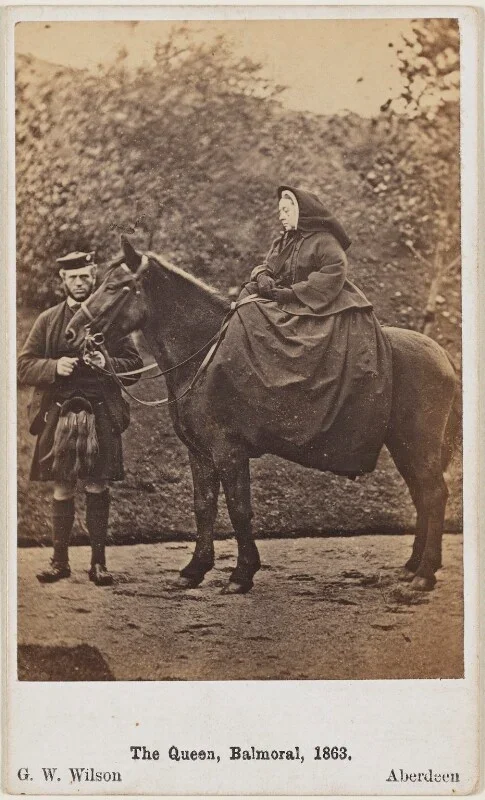
Queen Victoria had a deep, romantic love for the Scottish Highlands, which she first visited in 1842. Adopting it as her "land of freedom", she even published a popular book about her travels - ‘Leaves from the Journal of Our Life in the Highlands.’ She and Prince Albert established their beloved home at Balmoral Castle in Aberdeenshire, turning it into a royal retreat.
Queen Victoria played a pivotal role in the 19th-century Scottish cultural revival, transforming Highland traditions from a suppressed, regional culture into a fashionable, internationally recognized symbol of British national identity.
Through her deep personal affection for Scotland, her purchase of Balmoral Castle, and her frequent visits, she popularized tartan, Highland dress, piping, and the Scottish landscape.
Her deep affinity for Scottish culture was also defined by her close, albeit controversial relationship with her Scottish attendant, John Brown.
John Brown was born on 8 December 1826 at Crathienaird, Crathie and Braemar Aberdeenshire, to Margaret Leys and John Brown, and worked as an outdoor servant (in Scots gillie or ghillie) at Balmoral Castle.
Brown had several younger brothers and a sister, three of whom also entered the royal service. His brother Archibald Anderson "Archie" Brown, 15 years John's junior, eventually became personal valet to Victoria's youngest son, Prince Leopold, Duke of Albany.
By 1851, Brown's role changed from being Gillie and personal friend to Prince Albert to a "permanent role" as the leader of the Queen's pony.
Prince Albert's untimely death in 1861 was a shock from which Queen Victoria never fully recovered. Brown became a friend and supported the Queen helping her recover from deep depression. Victoria was known to give him many gifts as well as creating two medals for him, the Faithful Servant Medal and the Devoted Service Medal. She also commissioned a portrait of him in 1876, given to him on Albert's birthday, 26 August.
Victoria's children and ministers were not as accepting of the high regard she had for Brown, and rumours circulated that there was something improper in their relationship. Victoria herself dismissed the chatter as "ill-natured gossip in the higher classes”.
The diaries of Lewis Harcourt contain a report that one of the Queen's chaplains, Rev. Norman Macleod, made a deathbed confession repenting his action in presiding over Queen Victoria's marriage to John Brown. Debate continues over this report. Harcourt did not receive the confession directly (he was nine when Macleod died) but rather, it is claimed to have passed from Macleod's sister to the wife of Henry Ponsonby, the Queen's private secretary, and thence to Harcourt's father Sir William Harcourt, then Home Secretary. Harcourt served as Home Secretary in the final three years of Brown's life.
A letter from Victoria to Viscount Cranbrook, written shortly after Brown's death but rediscovered in 2004, shows how she described the loss:
“Perhaps never in history was there so strong and true an attachment, so warm and loving a friendship between the sovereign and servant [...] Strength of character as well as power of frame – the most fearless uprightness, kindness, sense of justice, honesty, independence and unselfishness combined with a tender, warm heart [...] made him one of the most remarkable men. The Queen feels that life for the second time is become most trying and sad to bear deprived of all she so needs [...] the blow has fallen too heavily not to be very heavily felt.”
A critically acclaimed British film, Mrs. Brown (1997), captures this story, starring Billy Connolly as John Brown and Dame Judi Dench as Queen Victoria. The film was noted for its excellent acting, particularly Judi Dench's Oscar-nominated performance, and its examination of love, loyalty, and exploration of the close, scandalous friendship between the grieving Queen and her Scottish servant. Available via Britbox and Amazon.
Happy Victoria Day!
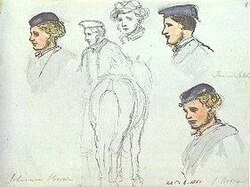
A young John Brown as sketched by Queen Victoria